
Graham County Court Records After Jail Arrest
Graham County is part of the Kansas 17th Judicial District. The arrest-to-court path usually runs from arrest, booking, and first appearance to prosecutor review, formal charging, district court hearings, and disposition. A booking label at the jail is not always the final charge. The court record becomes the better source once a complaint, information, or other charging paper is filed in Graham County District Court.
The custody side remains separate. For current jail status, the local contact path is the sheriff and jail, and the custody search is described in Graham County jail inmate records. For booking photos, use Graham County jail mugshots because Kansas law treats photo access differently from court docket access. Court records after a jail arrest focus on filed charges, status, court dates, and case events.
The Graham County District Court address published by the Kansas Judicial Branch is Graham County Courthouse, 410 N. Pomeroy Ave., Suite 9, Hill City, KS 67642. The Kansas courts district records page states that case information can include the case number, case type, parties, attorneys, judge assigned, and hearing dates.
Search Court Records After Jail Arrest
Kansas Case Search is the official public portal for Kansas district court case searches. It replaced the former public access portal and may require cookies, terms acceptance, account steps, identity checks, or CAPTCHA depending on the function. If a Graham County court record after arrest is not visible online, the clerk contact path still matters because some public records may be available through courthouse terminals or by request.
Source image: the Kansas Case Search portal is the statewide entry point for public district court searches.
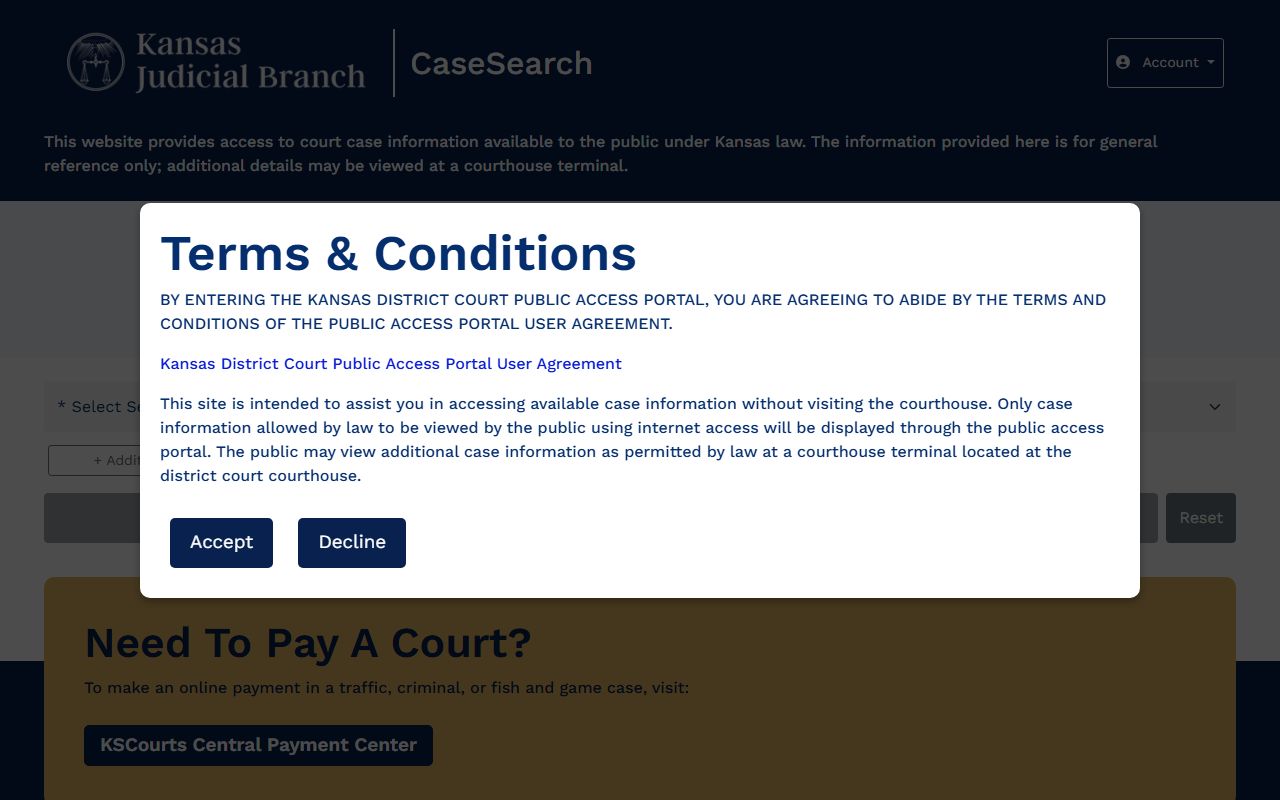
The portal is the best starting point once a prosecutor has filed a Graham County case, but it is not a live jail roster.
- Open Kansas Case Search and accept any required access terms.
- Search by defendant name first if the case number is not known.
- Narrow the result with a case number, citation, county, filing date, or other known detail when too many records appear.
- Open the case and read the case type, parties, charge entries, judge, attorneys, hearing dates, and disposition lines.
- Contact Graham County District Court if the online record is missing, unclear, sealed, or not yet indexed.
Graham County Case Search Fields
Kansas Judicial Branch materials identify several search paths that help find court records after a jail arrest. Defendant name and case number are the most direct for criminal matters. Citation searches can help traffic or citation-based cases, while attorney and cross-reference searches are useful when the person searching already has court paperwork.
| Field Label | Type | Required | Options or Format Notes |
|---|---|---|---|
| Case number | Search type / text | No | Use if known from a citation, complaint, warrant, or clerk notice. |
| Party name | Search type / text | No | Use the defendant name. Birth date helps separate similar names. |
| Business name | Search type / text | No | For organization parties rather than individual defendants. |
| Citation | Search type / text | No | Useful for traffic and citation-based criminal matters. |
| Attorney bar number | Search type / text | No | Listed in Kansas Smart Search guide materials. |
| Attorney name | Search type / text | No | Helpful when counsel is known. |
| Case cross-reference number | Search type / text | No | May appear on related case paperwork. |
| Smart Search | Search mode | No | Broad search mode referenced by Kansas Judicial Branch materials. |
Court Records After Jail Arrest Filings
After a Graham County arrest, the prosecutor decides what charge to file, whether to amend the booking label, and whether a case should proceed. The charging document is the formal court record that starts or frames the criminal case. It is different from the jail's intake record, and it can use different wording than the charge listed at booking.
| Document | Who Files It | What It Does | Practical Note |
|---|---|---|---|
| Complaint | Usually prosecutor, sometimes tied to officer information | States the charge and begins many Kansas criminal cases. | Often the first formal filing after arrest. |
| Information | Prosecutor | States formal charges after preliminary steps, waiver, or court process. | Can replace or refine earlier allegations. |
| Indictment | Grand jury | Charges an offense through a grand-jury process. | Less common, but still a formal charging path. |
Graham County research did not locate a current official county attorney page with a verified officeholder and full contact block, so court-record copy should not name a current prosecutor unless verified from an official source at publication time. The safer path is to search the court record and contact the clerk for public case access questions.
Graham County Charge Status
Charge status can change as court records after a jail arrest move through hearings. A count may be pending one week, amended later, dismissed before trial, or resolved by plea, diversion, trial, or other disposition. The filed court charge should be treated as more authoritative than a booking label, but the docket should still be read carefully because a single case can contain more than one count with different outcomes.
| Status | What It Means | Why It Matters |
|---|---|---|
| Pending | The charge has not reached final disposition. | Future hearings or filings may change the case. |
| Amended | The charge text, severity, statute, or count structure changed. | Compare the newest filing with the original booking label. |
| Reduced | A lesser charge replaced a more serious allegation. | The final charge may differ from the arrest description. |
| Dismissed | The court is no longer proceeding on that count. | Dismissal of one count may not end the whole case. |
| Diversion | Prosecution may pause under conditions approved in the case. | Public access and later expungement depend on Kansas law and the order. |
| Conviction | A plea or verdict resolved the charge against the defendant. | A conviction is different from arrest or accusation. |
Bond After Graham County Arrest
Bond and first appearance are part of the court path after a jail arrest. Under K.S.A. 22-2802, a person charged with a crime is addressed at first appearance before a magistrate, where release conditions can be set or reviewed. Those conditions can include an appearance bond, cash deposit, recognizance release, supervision, travel restrictions, no-contact orders, treatment evaluation, house arrest, or other terms.
For Graham County, current custody and local bond status should be checked with the Graham County Sheriff's Department at (785) 421-2107. Payment location should then be confirmed with the court or sheriff. K.S.A. 22-2802 states appearance bond or security is deposited in the office of the magistrate or clerk where release is ordered. No online Graham County bond payment method, kiosk rule, credit-card option, or after-hours bond instruction was located.
| Bond Type | How It Works |
|---|---|
| Appearance bond | A promise and set of conditions meant to assure appearance and public safety. |
| Cash bond | Cash deposited in place of sureties when permitted by the court order. |
| Surety bond | A bond backed by sureties or a bonding agent, unless the magistrate does not require sureties. |
| Recognizance release | Release based on a promise to appear, without a cash deposit. |
| Hold or detainer | A separate warrant, probation matter, KDOC hold, federal hold, ICE detainer, or court order that can block release. |
Warrants and Court Records
No official Graham County active warrant search, warrant list, or most-wanted page was located on the county site. Warrant questions should start with the Graham County Sheriff's Department for local custody issues and Kansas Case Search for related court cases. Bench warrants often arise from missed hearings or case-condition violations, while arrest warrants and probation or parole warrants may come from different agencies.
Not every warrant is public before service. Search warrants and investigative materials may be closed. If a person is booked on a warrant, the jail or court may be able to disclose the warrant basis, bond, issuing court, or hold status if releasable. Hill City Police Department has a public phone contact for city-police matters, but no city warrant list or separate city jail page was found.
Charge vs Conviction Records
Court records after a Graham County arrest must be read by stage. An arrest is not a conviction. A charge is the accusation filed in court. A conviction exists only after a guilty plea, no-contest plea accepted as a conviction, verdict, or other qualifying disposition. Public case records can show all three ideas in the same timeline, so labels matter.
| Point of Comparison | Charge | Conviction |
|---|---|---|
| Stage | Accusation filed in court. | Final or qualifying result against the defendant. |
| Proof level | Based on filing standards and probable cause. | Requires plea, verdict, or adjudicative outcome. |
| Can it change? | Yes. It can be amended, reduced, or dismissed. | Can later be appealed, set aside, or expunged only through legal process. |
| What to cite | Complaint, information, docket, or amended filing. | Disposition, judgment, sentence, or journal entry. |
Sealed vs Expunged Records
Kansas court records after arrest may be limited when a record is sealed, confidential, juvenile, protection-order-related, or expunged. Kansas expungement laws include K.S.A. 22-2410 for qualifying arrest records and K.S.A. 21-6614 for certain convictions, arrest records, and diversion agreements. Eligibility depends on the case, offense, timing, and court order.
| Point of Comparison | Sealed | Expunged |
|---|---|---|
| Public visibility | Hidden or restricted from normal public access by rule or order. | Public access is limited after the court grants an expungement. |
| How it happens | Can result from confidentiality rules, case type, or a specific court order. | Requires a qualifying petition or process under Kansas expungement law. |
| Who may still see it | Access depends on the statute or order that restricts the record. | Some agencies may retain limited access where Kansas law allows it. |
| What to do | Ask the clerk whether a public version or docket entry exists. | Review the Kansas statutes and the court's order before relying on public search results. |
Graham County Clerk Contact Path
If Kansas Case Search does not show the court record after a jail arrest, the next step is the Graham County District Court clerk path. The published court address is Graham County Courthouse, 410 N. Pomeroy Ave., Suite 9, Hill City, KS 67642. Ask for public access to the case by defendant name, case number, citation number, or approximate filing date. If the clerk cannot release a record, ask whether the case is sealed, confidential, juvenile, not yet indexed, or held in another court.
Source image: the Kansas Judicial Branch 17th Judicial District page lists Graham County District Court in the district court structure.
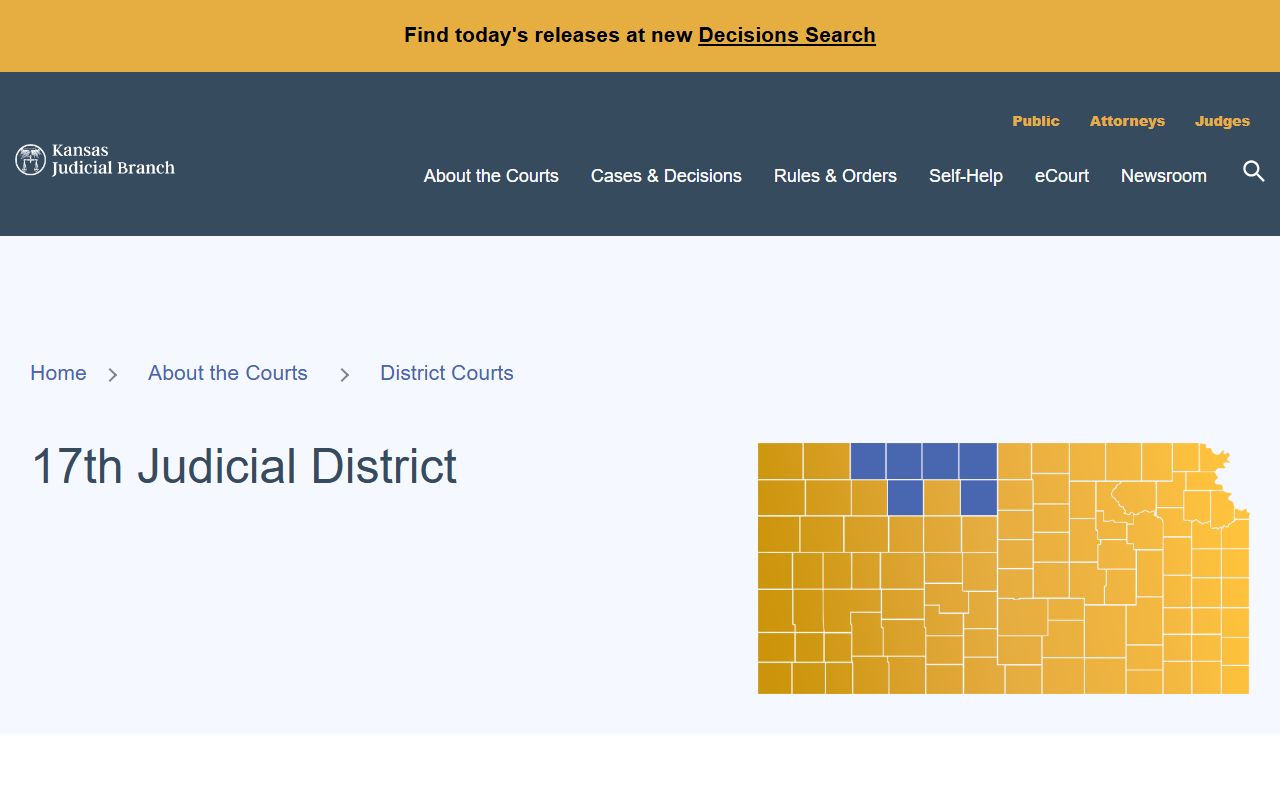
The district listing supports the clerk route when online case search does not answer a Graham County court-record question.
Restricted Court Records After Jail Arrest
Kansas public access is broad, but it is not absolute. K.S.A. 45-215, K.S.A. 45-218, and K.S.A. 45-221 shape public-record access and exceptions. The Kansas Attorney General explains that jail rosters and police blotters are open, but mug shots and standard arrest reports may be closed. Court records can also be limited by sealing orders, confidentiality rules, juvenile law, expungement, or ongoing investigation issues.
Background checks have a different legal role from casual court lookup. A public court search can help understand a case, but it should not be used as a consumer report for employment, tenant screening, credit, insurance, or other FCRA-covered decisions. For official criminal history, use the proper Kansas criminal-history channel or a compliant screening provider.
Important: Public court lookup is not a consumer report and should not be used for FCRA-covered screening decisions.